
The grandfather
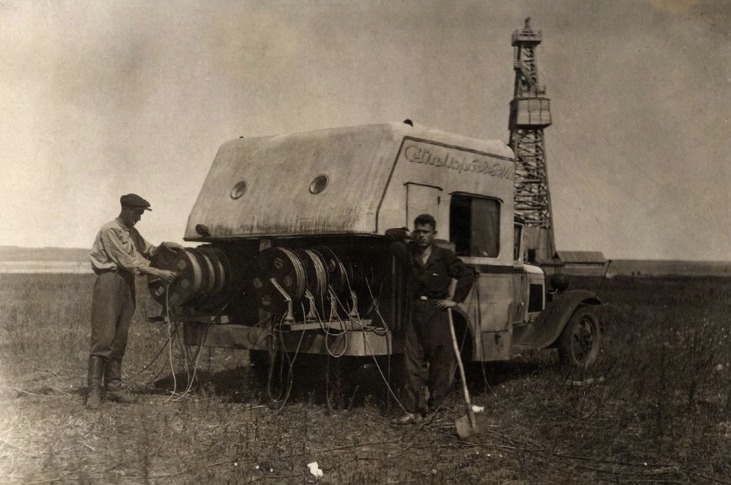
My grandfather on my father's side came from simple peasant stock — the kind who, a hundred years ago, got their first chance to study at university. He took it. My grandmother remembered him as a tidy, meticulous man: he could spend hours turning rock samples over on the table, examining them between his fingers as if talking to the stone. In both study and work, he acted as though something larger than the smallest detail depended on it.
Trained as a geologist, he took part in prospecting for oil deposits — the same ones that would define the country's energy fate for decades. But completing his assigned task wasn't enough for him. In the samples he studied for his main job, he also noticed traces of other deposits — copper, manganese — and recorded them, though nobody had asked him to. For years our family kept his collection of geological samples, in an amber-colored box of birdseye maple that my own father later made: a quiet testament that this man looked beyond his own assignment.
In February 1942 he was called to the front straight from an expedition. In August he was killed. My grandmother used to repeat a line from one of his letters — I pass it on as it survived in the family's memory: "The sum I spent on this expedition won't leave me in peace, and the conclusions, the report, the proposals are still in my head, and I've been drafted. Why not give me the chance to finish even two months' more work — people still haven't understood the full value of oil!" A man is sent to his death, and he's thinking about an unfinished report and a future he won't see. That spring of 1942, my grandfather carried an unfinished piece of work with him — but he didn't carry away who he was. That stayed with the son he barely got to know.
The father
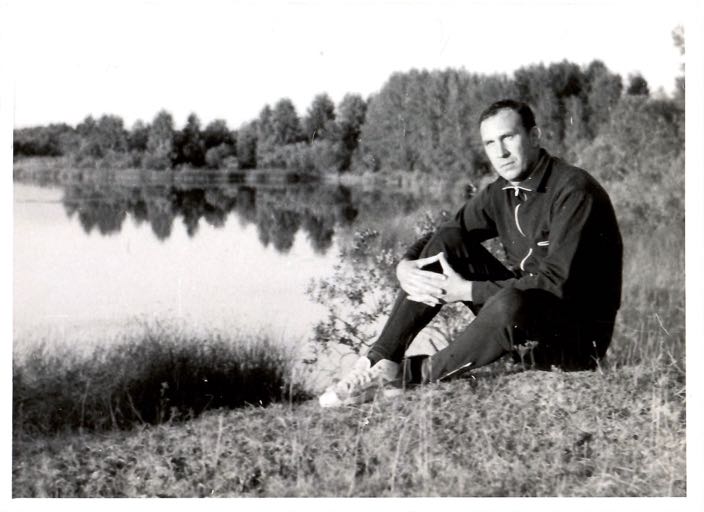
My father grew up without his own father — knowing him only through my grandmother's stories — and yet seemed to inherit him by ear: the same meticulousness, the same inability to leave something half-done. He graduated from an aviation university and went to work at a design bureau in aerospace. He stayed there almost forty-eight years. That company ran a sevenfold quality control process: a part he designed had to pass all seven independent inspections flawlessly — and he held himself to that standard his whole life, not just on paper.
The same rigor lived in him at home too. I remember when he designed a cabinet for our kitchen — a genuinely complex structure — and spent months perfecting the drawing on paper before he ever touched wood. That was how he approached everything else in woodworking too: that a piece should last centuries, that no one, under any circumstances, should find in it even the smallest flaw. I grew up in that environment, and from childhood that family rigor about work seemed to me not an eccentricity, but the norm everything else rested on.
The board that was no more
There was a day when my father and I were paneling the balcony of our apartment in wood. I picked up an old wooden jointer plane for the first time — heavy, polished smooth by years exactly where my father's hand had held it. We needed to true up the windowsill board — the last piece of oak we had; there was no more. I extended the blade a little more than I should have and ran the plane against the grain. The tool tore out a wedge of shaving, leaving a ragged gouge where a flat surface should have been. I'd ruined the board, and there was no material left for a second try.
My father came over, took the board in his hands, ran a finger over the tear — and said nothing. He just looked at me a moment longer than usual and went back to work, as if to say: this isn't the end, it's part of the road. What I felt then wasn't about the board. It was shame — that I, standing next to a man who for forty-eight years had answered for perfection across seven independent inspections, couldn't manage a single clean pass with a plane. That standard was still a long way off.
What's left after failure
The lesson, in the end, wasn't about how not to make mistakes. My grandfather never learned where the copper and manganese in his samples would lead — but he never stopped looking. My father couldn't promise himself that in forty-eight years he'd never miss a single flaw — but he held himself to that standard every day, regardless of outcome. And I, standing over the ruined board, understood the same thing differently than I would have from a book: it isn't about being flawless. It's about what you do after you've made the mistake — finishing the job, answering for the quality, not abandoning the work halfway just because it's gotten hard.
I picked up my father's hobby. After the workday, I'd go to my small workshop, which I'd set up myself at home, and there, among the shavings and the smell of fresh wood, I'd make tables, sofas, things for family and friends — the same way my father once made them for us.
Today
And then life collided with a war — the one unleashed by the state formed on my homeland's territory. The children had to be taken far from it, and my family and I moved to Spain. Here I decided the hobby deserved to become my life's work, and I opened a workshop — a professional one now, with a name, with clients, with the same rigor I inherited from my grandfather and my father.
Sometimes, working another board of oak, I remember that first tear in the windowsill. Today my hand doesn't shake — the blade sits level, the plane runs with the grain, not against it. What my grandfather never got to finish, my father perfected with no margin for error, and I didn't inherit a task or a trade in itself — I inherited a way of looking at the work: making it outlast you. And every time a perfectly flat surface comes out from under the plane, I know that's the answer I was finally able to give that board.