
Wood breathes, and that's not a metaphor. Wood cells absorb and release moisture throughout their life, and after the trunk is cut, dried, and turned into a table, the process doesn't stop. Solid wood keeps exchanging water with the air in the room. It's just that now the movement is measured in millimeters, not growth rings.
A little physics
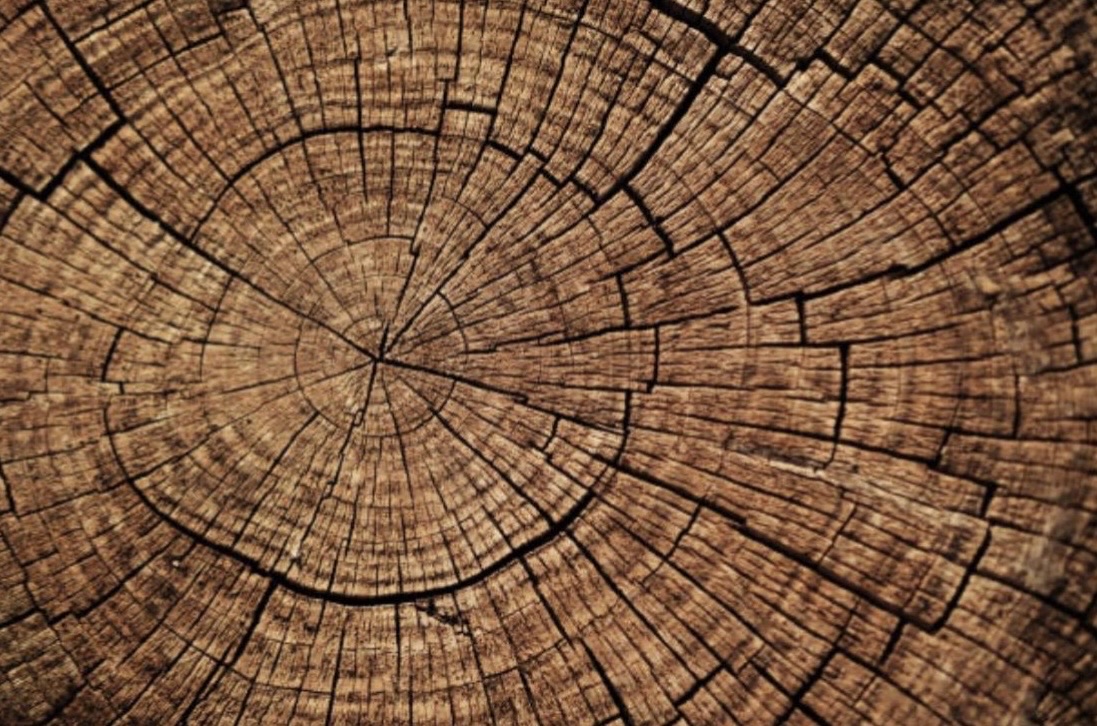
There's a concept called equilibrium moisture content: the state wood tends toward in a given room, at a given temperature and air humidity. In winter, when heating dries the air, wood releases moisture and contracts slightly. In summer, in the humid season, it takes moisture back and expands a little. This process has a direction. Along the grain, wood barely moves at all. Across it, tangential to the growth rings, shrinkage can be almost double what it is in the radial direction. That's where the warping comes from, and the characteristic gaps — exactly where physics predicts them, not chance.
A crack isn't always a break
Hairline cracks at the ends, especially near knots, appear because the surface dries faster than the core. That's simply how wood is built, not a flaw in the batch. Gaps in a tabletop's glued joints are also often left there on purpose: a good joiner leaves a technical margin, knowing the board will move. It's worth distinguishing a structural crack from a cosmetic one. The first runs through the full thickness and keeps growing — that one genuinely needs attention. The second stays on the surface and stabilizes on its own over time. It's easy to mistake one for the other if nobody explained beforehand what to expect.
Playing on ignorance
Veneer over MDF, and laminated boards, genuinely don't behave this way. They don't "breathe," because there's barely anything there to breathe — binding resins hold the structure motionless year-round. Some mass-furniture manufacturers sell that motionlessness as a virtue: "our furniture doesn't dry out or shift." What they leave unsaid is that this stability is bought at the cost of wood's living structure. The argument only works on a buyer who doesn't know that solid-wood shrinkage is a normal process, not a sign of cheap material or poor joinery. Solid wood, in fact, lasts longer precisely because of this movement, not in spite of it.
Two paths to reliability
Even within solid wood there's a choice, and it's worth knowing in advance. If the goal is a wide board, a single unbroken piece, with the grain pattern as whole as possible, that panel's reliability comes from added structural elements — dowels, battens, careful anchoring that holds the wide piece's geometry through seasonal movement. If instead you prefer the classic glued panel, reliability comes a different way — through the joinery technique itself: each stave's width, when glued, shouldn't exceed twice its thickness — a rule proven over generations of joiners. That makes the panel even more stable, and the grain pattern a little more broken up, built from narrower staves instead of one wide piece. Both paths are equally reliable — they just get there by different means, and choosing between them is a matter of taste and grain pattern, not a compromise on strength.
What the workshop sees
Years of working solid wood teach you to recognize these movements by sight. There's the door that sits slightly lower in winter and settles snugly back into its frame by summer. There's the tabletop where, in the dry season, a fine seam shows between the boards, and in the humid one it closes on its own. None of this needs repairing. It needs understanding. Good technique — floating tabletop mounts, compensation gaps, correctly oriented boards — doesn't fight wood's movement; it plans for it in advance.
Wood doesn't tolerate lies
This trait of solid wood has a flip side too, worth stating plainly. If what matters to you is absolute permanence of form, and any crack at an end or gap in a seam would cause worry rather than interest — solid wood may genuinely not be the material that makes you happy. That's not a criticism. MDF or veneer board has its rightful place, and predictability isn't the worst quality in a piece of furniture. But whoever chooses solid wood should choose it knowingly: along with its seasonal movement, its hairline cracks, and its quiet insistence on remaining a living material even years after the tree stopped growing.