
Oak takes its time. It grows slowly, lives long, and behaves in the workshop with the same solidity it has in the forest. But not all oaks are alike: European and American oak are cousins, not twins — and in a piece of furniture, the difference shows at first glance.
Two oaks, two characters
Pedunculate oak, Quercus robur, is old Europe: France, Germany, the Balkans, central Russia. Ships were built from it, altars carved from it. Related but not identical is American white oak, Quercus alba — a wood of the eastern states, of a different temperament, though not of lesser quality. There is also American red oak, Quercus rubra: its physical and chemical properties differ noticeably from both white and European oak, and it rarely goes into premium furniture — more often into utilitarian pieces.
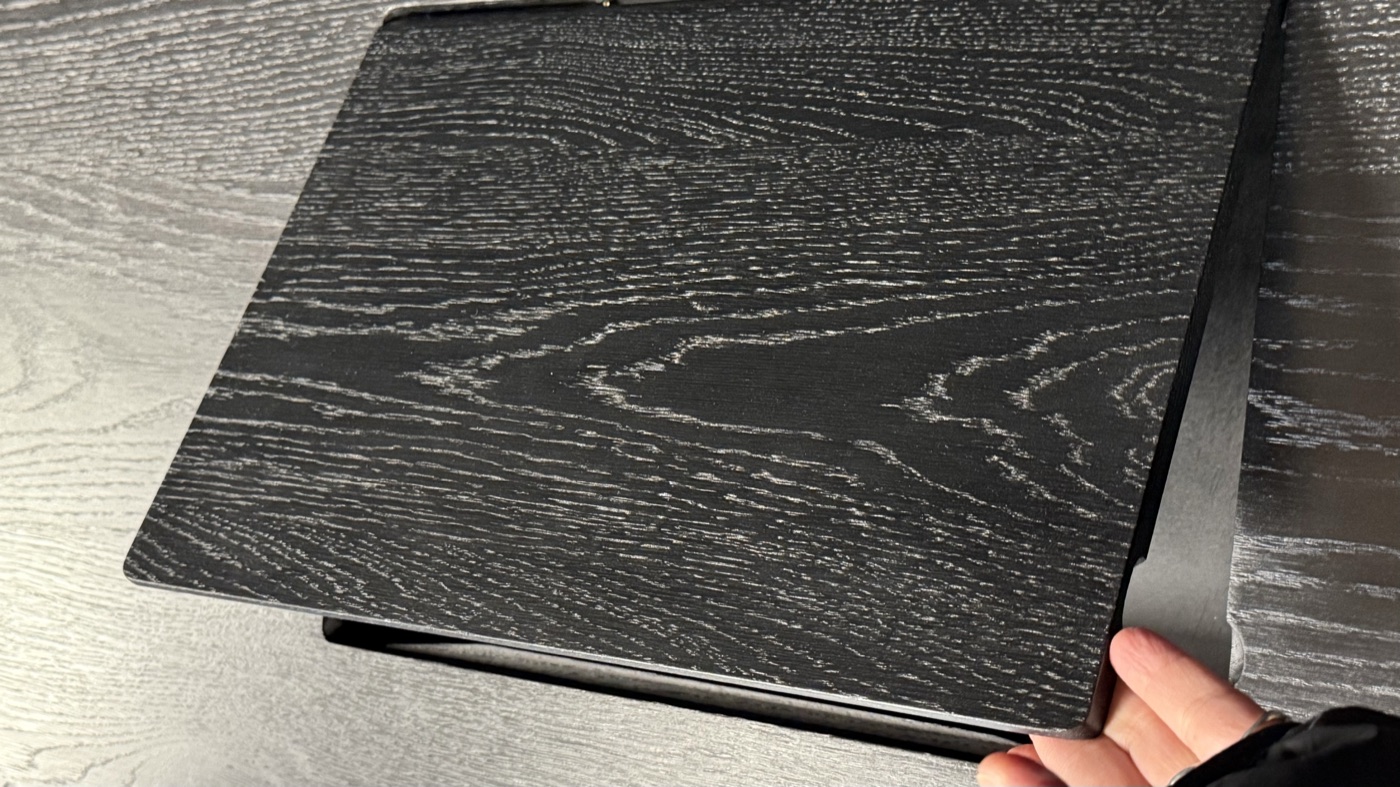 European Oak
Grain and color: a tale of two textures
Take a board of each — the difference is visible immediately. In European oak, the growth rings sit evenly, calmly, and on a radial cut — one sliced along the direction of the trunk's rays, rather than tangentially across the growth rings — something unexpected appears: the medullary rays, wide and bright, like veins of light breaking through a canopy. But seeing them at their fullest isn't simple. In an ordinary tangential cut, barely ten boards in a hundred come out radial. Cutting the whole trunk radially drops total yield to 60% of what a tangential cut gives. That's why furniture made from such a board isn't an ordinary product — it's a singular piece, priced accordingly.
American oak has a different nature. The grain is bolder, more contrasted, the rings read more sharply — which is why its texture is sometimes called "cathedral grain." Color, though, is less predictable: the wood's tone depends heavily on the specific batch. One batch of European oak may come out pale, another nearly as dark as tanned leather; the same is true of American oak. Any craftsman who has worked with both will tell you the same thing: the numbers in reference books are an average, not a guarantee.
Body and sap: a little physics and chemistry
American white oak is denser and heavier than European oak, and noticeably harder. In practice, this means a tabletop or armrest in American oak will rarely carry the mark of an accidental knock or a dropped object. Where European oak might dent, American oak's surface tends to stay unmarked. That's why it's often chosen for heavy-use furniture — kitchen tables, bar counters, children's rooms.
Chemistry is another story. Both woods are rich in tannins, which once protected the trunk from rot and insects, and today determine how the wood behaves in the workshop: how it takes stain, its acidity (hence the pickiness with glues and finishes), and how readily it responds to iron acetate treatment — a way to reach a deep, dark tone without any paint at all. European oak generally holds more tannin, so it responds better to fuming and patination — American oak, with less tannin, needs more patience to reach that same dark tone. It's a difference every joiner weighs before choosing a glue, a finish, or the treatment itself.
Use: the aristocrat and the workhorse
European oak is more often chosen for pieces meant to last decades: solid furniture, staircases, manor-style doors — a premium segment that favors carving and dark patina. American oak stays simpler and more direct: veneer, contemporary furniture, Scandinavian aesthetics, industrial design without excess ornament. One speaks the language of tradition; the other, the language of today.
Origin
Here both species share similar questions: legality of harvest, FSC certification, logistics. The difference is mostly one of distance — American oak's journey to the workshop is, objectively, longer.